


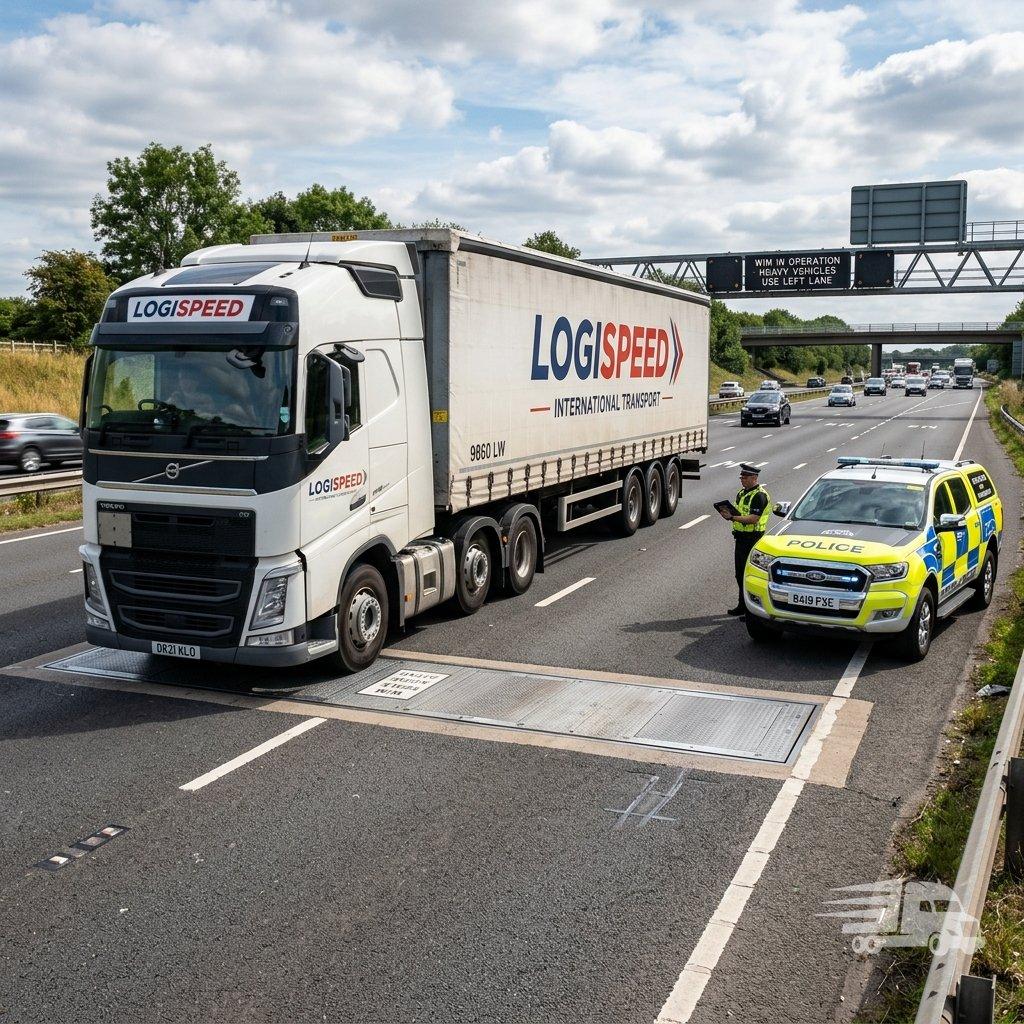
How automatic Weigh-in-Motion systems are being deployed across European road networks to enforce axle load and dimension limits. Penalties, technical requirements, and how carriers can ensure compliance.
Weigh-in-Motion: From Data Collection to Automated Enforcement
Between 2023 and 2026, at least seven jurisdictions — including Austria, the Czech Republic, Switzerland, and multiple EU member states — achieved or advanced type-approved direct enforcement using high-speed WIM. This marks a decisive threshold in road freight enforcement: Weigh-in-Motion technology is crossing from passive data collection into automated, legally binding weight enforcement without stopping vehicles.
WIM systems are integrated into road surfaces and measure freight vehicle parameters continuously at full traffic speed:
Recording gross vehicle weight and individual axle loads.
Capturing overall dimensions — height, width, and length — of the vehicle combination.
Reading licence plates via high-precision cameras.
Automatically transmitting data to enforcement authority databases for penalty issuance.
Modern WIM systems operate 24/7, providing precise identification of overloaded vehicles regardless of time of day or traffic conditions. Vehicles complying with limits are directed to bypass; those flagged as overweight are directed for further inspection.
EU Weight and Dimension Limits: What Every Carrier Must Know
Under EU Directive 96/53/EC — the core European framework governing truck weights and dimensions — the standard limits for international road freight are:
Maximum gross vehicle weight (GVW): 40,000 kg for a standard 5-axle articulated combination (3-axle tractor + 2-axle semi-trailer).
Extended GVW to 44,000 kg: permitted for intermodal transport (container on road + rail or road + short-sea combined transport chains), documented under EC Directive 96/53.
Maximum axle loads: 10 tonnes for a single non-driven axle; 11.5 tonnes for a driven axle.
Maximum trailer length: 16.5 m for a semi-trailer alone; 18.75 m for the full combination.
National enforcement varies across member states: Germany strictly enforces 40 tonnes GVW; Belgium and several other countries allow 44 tonnes for 4+ axle combinations; Finland and Sweden permit combinations up to 60 tonnes under their own national regulations. Switzerland limits GVW to 40,000 kg on non-motorway routes, and Norway applies seasonal spring thaw load restrictions.
Any vehicle or load exceeding standard width (2.55 m) or height (4.0 m as a general threshold) requires advance permits from each country on the route, with applications typically submitted 5–10 working days before the move.
Penalties for Overloading Across Europe
National governments set their own penalty structures for weight and dimension violations. Under EU rules, member states must implement automatic detection systems on the TEN-T core network and report overloading detection data to the European Commission every two years. Fines vary significantly by country — from several hundred euros for minor violations to thousands of euros for serious exceedances — and repeated violations can result in vehicle immobilisation and operational restrictions.
The European Parliament's position (2024/AP0126) calls for certified automatic WIM systems to be deployed as a minimum across the trans-European road transport network, and for systems to recognize vehicles with valid special permits to avoid unjustified penalties.
How to Protect Your Fleet from Overloading Violations
To ensure your vehicle's payload capacity complies with applicable weight limits, always verify technical specifications and restrictions for your fleet in the fleet management module on CarGoPro. Cargo owners can also specify the exact cargo weight when creating a cargo request to avoid discrepancies with carriers at weigh stations and prevent costly delays, fines, or mandatory reloading on route.